Hourglass Body Shape: Guide, Traits & Style Tips
Here is something that might surprise you: according to a large-scale body measurement study conducted at North Carolina State University, only about 8% of women have a true hourglass figure. Eight percent. Out of 6,318 women measured, fewer than one in twelve met the precise criteria.
And yet, if you asked women in a room to raise their hand if they think they might be hourglass-shaped, somewhere between 30 and 40 percent of hands would go up. That gap — between who thinks they have it and who actually does — is the most important thing to understand before reading another word about this body shape.
This is not said to discourage you. It is said because misidentifying your shape leads to following styling advice that was designed for a completely different set of proportions — and then wondering why the clothes never quite work. If you are pear-shaped, pear-shape advice will transform your wardrobe. If you follow hourglass advice while being pear-shaped, it will feel consistently off.
This guide will tell you exactly how to confirm whether you have an hourglass figure, what the measurements actually mean, how to dress it when you do, and — just as usefully — how to tell when you might be a close-but-different shape instead. There is a free body shape calculator that takes your three measurements and gives you an instant answer. But read the measurement guide first, because the numbers only tell the truth if you take them correctly.
What Is the Hourglass Body Shape?
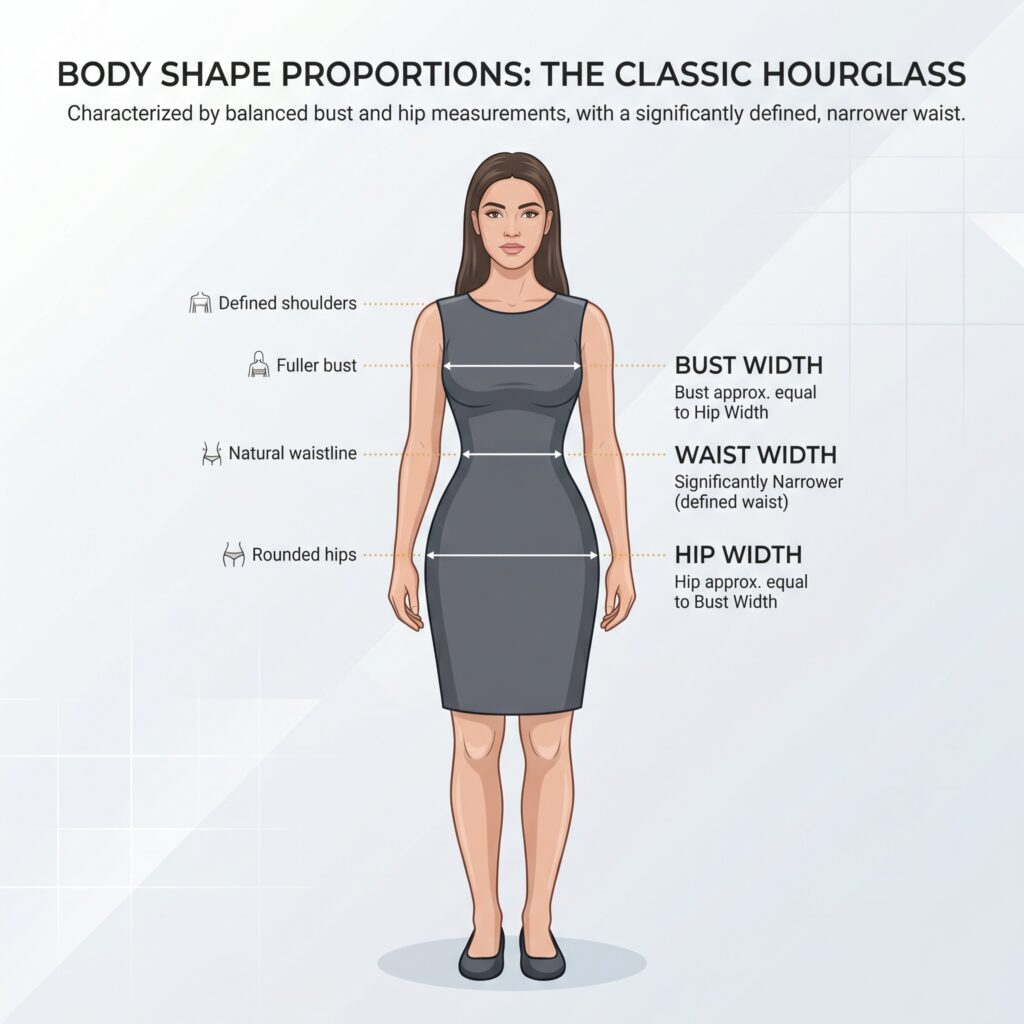
The hourglass body shape is defined by a very specific proportional relationship between three measurements: the bust, the waist, and the hips.
In simple terms: your bust and hips are approximately equal in width, and your waist is significantly narrower than both. The visual result is a silhouette that widens at the chest, narrows sharply at the middle, and widens again at the hips — like the upper and lower chambers of an hourglass, connected by a narrow centre.
The key word in that description is approximately equal. The bust and hips do not need to be identical. A difference of one to two inches between them is well within the hourglass category. What matters more is the dramatic inward curve at the waist — the defining feature that separates an hourglass from every other shape.
The Hourglass Formula
Bust and hips: within 1–2 inches (2.5–5 cm) of each other
Waist: at least 9 inches (23 cm) narrower than both bust and hips
Waist-to-hip ratio (WHR): typically 0.65–0.75
Classic example: 36–26–37 inches → Hourglass ✓
Another example: 40–30–41 inches → Hourglass ✓
Counter-example: 34–27–39 inches → Pear shape (hips too wide relative to bust)
The hourglass shape is named after the glass instrument used to measure time — and if you look at the silhouette from the front, the resemblance is immediate. Wide at top, narrow in the middle, wide at the bottom, with both the top and bottom roughly matching each other in width.
How to Confirm You Have an Hourglass Figure
Before anything else, you need accurate measurements. This is where most self-assessments go wrong — people estimate, or measure in the wrong position, or use the wrong point on the body. Take five minutes to measure properly and your result will be reliable.
You need a soft fabric measuring tape — the kind used in tailoring. Metal tapes are rigid and cannot curve around the body accurately. Stand straight in minimal clothing, feet together, and breathe normally. Do not hold your breath or pull your stomach in.
Where to Measure
- Bust: Around the fullest part of your chest, at nipple level. The tape should be parallel to the floor. Wear a non-padded, well-fitting bra — padding adds volume that does not belong to your measurement.
- Waist: Around the narrowest point of your torso. This is NOT at your navel — it is usually one to two inches above it. A useful trick: bend gently to one side. The crease that forms is your true natural waist.
- Hips: Around the fullest part of your hips and seat, typically 7 to 9 inches below your waist. Stand with feet together and make sure the tape is level across the back.
The Waist-to-Hip Ratio (WHR) Check
Once you have your measurements, calculate your waist-to-hip ratio. This is the most precise individual number for confirming hourglass proportions.
WHR Formula:
WHR = Waist ÷ Hips
Example: Waist 27″ ÷ Hips 37″ = WHR 0.73 → Classic hourglass range
Hourglass WHR: typically 0.65 to 0.75
Above 0.80 in women = not typically hourglass (waist too close to hip width)
You can skip the manual calculation by using the free WHR calculator — enter your waist and hip measurements and it returns your ratio and classification instantly.
A quick note on plus-size hourglass proportions: the specific measurements do not determine whether you are hourglass — the ratios do. A woman with a 44-inch bust, 33-inch waist, and 45-inch hips has the same hourglass proportions as someone measuring 34-24-35. The category is entirely about the relationship between measurements, not their absolute value. Size has nothing to do with it.
Not sure about your measurements or result? The female body shape calculator checks all five categories simultaneously — hourglass, pear, apple, rectangle, and inverted triangle — so you know not just your shape but how close you are to any adjacent ones.
How Rare Is the Hourglass Figure? The Research
The number cited earlier — 8% — comes from a genuinely significant piece of research. In 2005, North Carolina State University conducted the SizeUSA study, measuring the body proportions of 6,318 women across the United States. The findings showed that only about 8% of participants had true hourglass proportions.
The most common shape in the study was the rectangle (also called banana), accounting for roughly 46% of participants. Pear shapes came in second at just over 20%, followed by apple shapes at just under 14%.
Why does this matter? Because hourglass is the most depicted, most aspired-to, and most discussed female body shape in fashion media — and yet it is one of the least common. The result is a significant number of women who identify as hourglass but have proportions that technically place them in another category, most often pear, bottom hourglass, or spoon.
This is not a criticism. Many women have proportions that are genuinely close to hourglass without meeting the strict mathematical criteria. The adjacent shapes — particularly the bottom hourglass (hips very slightly wider than bust with a defined waist) and the spoon shape — are closely related and share many styling principles. If you are in the grey zone, the advice for both shapes applies to you.
Hourglass vs Pear Body Shape: The Single Deciding Measurement
This comparison is the most searched body shape question for a reason. The two shapes feel similar from the inside — both have a defined waist and fuller hips — but they are styled differently, and confusing them produces reliable frustration in the fitting room.
The deciding measurement is always the same: the bust-to-hip difference.
| Feature | Hourglass | Pear (Triangle) |
|---|---|---|
| Bust vs Hips | Within 1–2 inches of each other | Hips 2+ inches wider than bust |
| Waist Definition | Strongly defined (9″+ narrower than bust and hips) | Clearly defined, but relative to hips only |
| WHR | 0.65–0.75 | 0.70–0.78 |
| Upper Body | Balanced with lower body | Noticeably narrower than hips |
| Primary Styling Goal | Honour the waist — never conceal it | Add visual width to the upper body |
| Example Measurements | 36–26–37 or 38–28–39 | 34–27–39 or 36–28–41 |
The practical test: look at your bust measurement and your hip measurement side by side. If they are within two inches of each other and your waist is strongly defined, you are hourglass. If your hips are more than two inches wider than your bust, you are pear — even if the waist definition feels similar.
Both are beautiful shapes with clear, effective styling strategies. The full pear body shape guide covers that shape in detail if the comparison points you there.
Best Clothes for an Hourglass Body Shape
The single most important styling principle for the hourglass figure is this: work with the waist, not against it. Your waist is the most architecturally interesting feature of this frame — the natural narrowing between two balanced halves. Garments that acknowledge it will look polished. Garments that ignore it waste the frame’s strongest asset.
Dresses That Work Best
Wrap dresses were practically invented for the hourglass figure. The construction — fabric crossing and tying at the natural waist — automatically mirrors the shape’s proportions, following the bust, cinching at the waist, and opening toward the hip. Any fabric weight works, though jersey and crepe drape the curves more naturally than stiff wovens.
Fit-and-flare dresses are equally reliable: fitted through the bodice and waist, then flaring at the hip. They echo the shape’s natural silhouette. Bodycon dresses in stretch fabrics work well because the elasticity accommodates the waist-to-hip difference without pulling or bunching. Midi lengths are particularly flattering as they draw the eye toward the hem and create an elongated, balanced overall look.
The one dress style to reconsider: the straight shift dress, which hangs from shoulder to hem with no waist acknowledgement. It technically fits — but it reads as shapeless on this frame because it conceals the defining feature.
Tops and Blouses
Any top that acknowledges or sits at the natural waist works well. Wrap tops, peplum tops, and blouses that tuck in easily give the waist definition without effort. V-necklines and scoop necks elongate the chest and draw the eye both upward and downward — creating a visual lengthening effect that balances the naturally rounded curves below.
Avoid hip-length tops that end at the widest part of the hip without any waist tuck or definition — these add visual weight at the hip while obscuring the waist, which works against this shape’s proportions.
Trousers, Jeans, and Skirts
High-waisted anything is an excellent starting point. High-waisted trousers, high-waisted jeans, and high-waisted skirts all sit at or near the natural waist, which is the narrowest point of the hourglass frame — making the waist-to-hip ratio immediately visible.
For jeans specifically: straight-leg, bootcut, and wide-leg cuts all work, though the priority is always the waist fit. Many hourglass women find that jeans fit beautifully at the hip but are slightly loose at the back waistband — a common fit issue caused by the difference between waist and hip circumference. Mid-rise to high-rise cuts help significantly; low-rise rarely works because the waistband sits on or near the hip rather than the true waist.
A-line and flared skirts follow the natural silhouette from the waist down. Pencil skirts work well in stretch fabrics but can cause pulling in rigid wovens because the hip-to-waist difference creates tension at the waistband.
Swimwear
The hourglass frame generally carries swimwear well because most swimsuit styles are cut to create the waist-to-hip contrast this shape already has. One-piece swimsuits with cut-outs or ruching at the waist are particularly effective — they frame the waistline from both sides. Wrap-front bikini bottoms and underwire or structured bikini tops provide the support the fuller bust often needs while keeping proportions balanced.
Jackets and Outerwear
Fitted blazers with a defined waist seam — not boxy or oversized — are the signature outerwear piece for this shape. They structure the upper body while following the curve at the waist. Belted coats and trench coats are equally strong choices. The belt should always be fastened at the natural waist, not the hips.
Calculate your body shape to confirm your measurements before shopping.
Styling Choices That Work Against Hourglass Proportions
There are no rules in personal style — only physics. These are the garment choices that work against hourglass proportions, and understanding why each one does that makes it much easier to decide when you want to follow the principle and when you want to break it deliberately.
- Oversized, boxy tops: They conceal the waist entirely, removing the shape’s most defining feature from view. If you want the oversized look, balance it with high-waisted, well-fitted bottoms that keep the waist visible.
- Shapeless shift dresses in stiff fabrics: They hang straight from shoulder to hem with no acknowledgement of the waist curve. The shape looks better in garments that follow the body rather than passing over it.
- Empire-waist styles that start above the natural waist: These can work well on apple shapes but tend to cut the hourglass silhouette at the wrong point — drawing the eye to a seam that sits above the natural waist and making the torso look shorter.
- Wide belts worn at the hip rather than the waist: A belt worn at the hip adds visual width at the widest point of the frame rather than defining the narrowest point. The natural waist is always the right belt placement for this shape.
- Very stiff fabrics with no stretch through the hip: Rigid wovens can pull at the hip seam because the waist-to-hip measurement difference is significant. Stretch fabrics or looser cuts through the hip solve this immediately.
Indian Ethnic Wear for the Hourglass Figure
Most body shape guides focus exclusively on Western fashion. For Indian women — or anyone who wears sarees, lehengas, kurtis, and salwar suits regularly — that leaves a significant practical gap. The good news is that Indian ethnic clothing offers some of the most naturally flattering silhouettes for the hourglass shape, because the garment tradition has long celebrated defined waists and balanced curves.
Saree Styles for Hourglass Body
The saree is one of the most versatile garments in the world, and the hourglass figure can wear almost any draping style beautifully. The priority is the blouse — the fitted upper piece that defines the bust and waist before the saree fabric is draped around it.
Deep-neck, boat-neck, and backless blouse styles all work very well. They frame the upper body without adding bulk at the shoulder, and they allow the waist of the blouse to be clearly fitted at the natural waist point. Avoid very wide, structured blouse sleeves that add horizontal bulk to the shoulder line — the hourglass frame does not need additional width at the top.
For draping style, the Nivi drape — the most common in South India — works beautifully because the pleats sit at the front hip, the pallu falls over the shoulder, and the midriff between blouse and saree remains visible, highlighting the waist. The Bengali drape, where the saree is wrapped around the waist and the pallu crosses over the chest, also flatters this shape by creating a diagonal line that leads the eye from hip to shoulder.
Lehenga Styles
The lehenga-choli combination is almost made for the hourglass proportions. A fitted or structured choli (blouse) at the natural waist paired with any lehenga skirt silhouette creates the classic hourglass visual. For formal and bridal occasions, a heavily embellished choli with a contrasting full skirt is particularly striking.
Mermaid-cut lehengas — fitted through the hips and flaring below the knee — are the most dramatic option for this shape. They follow the body’s contour from waist to hip and then flare outward, echoing the hourglass silhouette in a very direct way.
A-line lehengas with a defined waistband are the most versatile everyday choice — they work in any fabric weight and for any occasion from casual to formal.
Kurta and Kurti Styles
For everyday ethnic wear, the princess-seam kurta is the best starting point for an hourglass frame. The vertical seaming follows the body’s contour through the bust, waist, and hip, making the shape’s proportions visible without being clingy. Fitted kurtas that are slightly structured through the torso and slightly relaxed through the hem create a polished, balanced look.
Wrap-style kurtis are equally effective — for the same reason wrap dresses work in Western fashion. The tied waist naturally creates definition at the narrowest point. Peplum kurtis add a gentle flare at the hip that echoes the hourglass proportion.
The styles to reconsider: very straight, box-cut kurtis that run from shoulder to hem without any shaping, and heavily embellished kurtis with bulk concentrated at the torso rather than the waist or hem.
Bollywood style note: Deepika Padukone and Aishwarya Rai are both frequently cited examples of classic hourglass proportions, and their ethnic wear styling consistently demonstrates the principles above — fitted blouses with defined waists, A-line or mermaid lehengas, and saree draping styles that keep the midriff and waist visible.
Hourglass Body Shape and the Kibbe System
The Kibbe body type system is a separate classification entirely from measurement-based body shape analysis. While body shape calculators classify proportions from numbers, Kibbe classifies the overall quality of your physical lines — the sharpness or softness of your bones, the quality of your flesh, and your facial features — using a yin (soft, rounded) and yang (angular, structured) framework.
This matters because an hourglass measurement result does not automatically correspond to any single Kibbe type. However, there are patterns worth knowing.
The Kibbe types most commonly associated with hourglass measurement proportions are:
- Romantic: The most yin of all types. Soft, rounded bone structure throughout, lush curves, delicate rounded features. This type is typically under 5’5″. The Romantic almost always has hourglass measurements because the defining characteristic is balanced upper and lower curves with a soft waist.
- Theatrical Romantic: Like the Romantic, but with some yang contrast — slightly sharper facial features or a small amount of angular bone structure alongside the predominantly soft, curved frame. Also tends to have hourglass proportions.
- Soft Dramatic: The tall end of the spectrum. Soft Dramatics have the elongated, yang-dominant bone structure of the Dramatic type, but with significant yin curves — a full bust, rounded hips, and soft flesh. Many Soft Dramatics have hourglass measurements despite being classified on the yang side of the spectrum.
An important caveat: the Kibbe system considers height, facial features, and bone quality — none of which a measurement calculator captures. A person with exact hourglass measurements could be a Romantic, a Soft Natural, or a Dramatic Classic depending on their other physical qualities. The systems are complementary, not identical.
For a complete Kibbe assessment, the Kibbe body type test guide covers all 10 types in detail. The Kibbe body type calculator provides an interactive result alongside your measurement-based shape.
Fitness and the Hourglass Frame
The hourglass shape is most commonly associated with a mesomorph or endo-mesomorph somatotype — a natural tendency toward curves, relatively efficient muscle building, and a frame that carries both fat and muscle in a balanced way across the upper and lower body.
For fitness, the goal that most people with this shape have is maintaining the proportional balance between the upper and lower body — keeping the shoulders and hips roughly equal in width while supporting a strong, stable core at the waist. The compound exercises that do this best are:
- Squats and hip thrusts: Maintain and develop the glute and hip muscle that keeps the lower body proportionally strong
- Rows and lat pulldowns: Maintain the upper-back width that keeps the shoulder-to-hip ratio balanced
- Deadlifts: Full-body compound movement that develops both the upper back and the posterior chain simultaneously
- Pilates and core work: Supports the waist definition that is the frame’s centrepiece — particularly the transverse abdominis and obliques
For nutrition and metabolism context alongside your shape, the somatotype calculator identifies your natural build tendency and provides tailored guidance for training and eating to your body’s specific patterns.
Celebrities With an Hourglass Body Shape
Looking at celebrity examples can be useful for understanding what the shape looks like across different heights and sizes — and, more practically, for seeing how different styling choices work on the frame in real life.
Western celebrity examples: Marilyn Monroe (the most cited classic example), Beyoncé, Scarlett Johansson, Sofia Vergara, Salma Hayek, Kim Kardashian, Christina Hendricks, and Kate Winslet are all regularly identified as having hourglass or near-hourglass proportions. Notice the range: from petite to tall, from size small to size large — what they share is the bust-to-hip balance with a defined waist, not a specific size or weight.
Bollywood and Indian celebrity examples: Aishwarya Rai Bachchan is one of the most frequently cited examples of classic hourglass proportions in Indian cinema. Deepika Padukone, Katrina Kaif, and Madhuri Dixit are also commonly referenced. Their styling choices across both ethnic and Western wear consistently demonstrate the principles in this guide — defined-waist garments, fitted blouses in ethnic wear, and wrap or bodycon dresses in Western contexts.
One important caveat about celebrity examples: body shapes are classified from measurements, not from photographs, and photographs are consistently altered. Celebrity examples are useful illustrations of styling principles, not exact measurement references.
Frequently Asked Questions
What is the best dress style for an hourglass figure?
Wrap dresses, fit-and-flare dresses, and bodycon dresses in stretch fabrics are the three most consistently flattering dress styles for an hourglass figure. All three acknowledge and frame the waist — the defining feature of this shape. The key principle: any dress that sits at, defines, or follows the natural waist will work well. Avoid straight shift dresses that hang from shoulder to hem without any waist shaping.
How do I know if I have an hourglass body shape?
Measure your bust (around the fullest part of the chest), your waist (at the narrowest point of your torso, about 1–2 inches above the navel), and your hips (at the widest part of the seat). If your bust and hips are within 1–2 inches of each other AND your waist is 9 or more inches narrower than both, you have hourglass proportions. For an instant result, enter your measurements into the free female body shape calculator.
How rare is the hourglass body shape?
Very rare. A 2005 study conducted at North Carolina State University — the SizeUSA study, which measured 6,318 women — found that only approximately 8% had true hourglass proportions. Rectangle shapes were most common at around 46%, followed by pear shapes at just over 20%. Despite being the most depicted shape in fashion media, the hourglass is one of the least common in reality.
What is the difference between hourglass and pear body shape?
The deciding measurement is the bust-to-hip difference. An hourglass has a bust and hips that are within 1–2 inches of each other — both are approximately equal in width. A pear shape has hips that are more than 2 inches wider than the bust. Both shapes have a defined waist, but only the hourglass has a balanced upper-to-lower body proportion. If your hips are noticeably larger than your bust, you are pear-shaped, not hourglass.
What jeans suit an hourglass body shape?
High-waisted jeans in straight-leg, bootcut, or wide-leg cuts work best. The high waist sits at the narrowest point of the frame and makes the waist-to-hip ratio immediately visible. Many hourglass women find standard jeans fit well at the hip but gap at the back waistband — high-rise or mid-rise cuts help. Avoid low-rise jeans: the waistband sits at the widest part of the hip rather than the true waist, which works against this shape’s proportions.
Which Kibbe body type is hourglass?
Hourglass measurements most commonly correspond to the Romantic, Theatrical Romantic, or Soft Dramatic Kibbe types — depending on height, bone structure, and facial features. The Romantic type (petite, very soft and rounded throughout) almost always has hourglass proportions. The Soft Dramatic (tall with significant curves alongside a more angular bone structure) also frequently produces hourglass measurements. However, a measurement-based hourglass result does not automatically determine your Kibbe type — the systems use different criteria. Try the Kibbe body type test for your full result.
What is the top hourglass body shape?
The top hourglass is a variation where the bust is slightly larger than the hips — usually by less than two inches — while the waist remains strongly defined. The overall proportions are still balanced and the shape still falls within the hourglass category. Styling follows the same principles as the standard hourglass: define and frame the waist. The slight bust dominance means structured, supportive tops and fitted bodices are particularly important.
Can an hourglass body shape change over time?
Yes. Your bone structure — the width of your shoulder bones, hip bones, and rib cage — is permanent from skeletal maturity. But fat distribution and muscle mass change with age, pregnancy, hormonal shifts, and training. The hormonal changes of menopause commonly redistribute fat from the lower body toward the midsection, which can widen the waist measurement and reduce the WHR contrast. Consistent strength training and core work can help maintain the waist-to-hip ratio over time. Recalculate using the body shape calculator every 6 to 12 months.
What workout is best for an hourglass body shape?
The most effective workouts for maintaining hourglass proportions combine compound lower-body exercises — squats, hip thrusts, deadlifts — that develop the hip and glute muscles, with upper-body pulling exercises — rows, lat pulldowns — that maintain the shoulder-to-hip proportional balance. Core work, particularly exercises targeting the transverse abdominis and obliques, supports the waist definition that defines this shape. For nutrition and training guidance tailored to your natural build, use the somatotype calculator.
CONCLUSION — Paste as Final Paragraph Blocks
The hourglass body shape is one of the most talked-about and least commonly occurring female silhouettes. That gap — between cultural prominence and statistical rarity — is why so many women spend years following advice that was not written for their actual proportions.
If the measurements in this guide confirm you are hourglass-shaped, the styling principles are straightforward: define the waist in everything you wear, choose garments that follow the body’s natural contour, and trust that the shape works best when it is visible rather than concealed. For Indian ethnic wear, the same principle applies from fitted choli blouses to the choice of saree drape.
If the measurements point you toward a different shape — pear, bottom hourglass, or rectangle — the good news is that each of those shapes has its own equally clear and effective styling framework. The most useful thing you can do right now is confirm your shape with three measurements and start from the right place.
Your next step: Measure your bust, waist, and hips right now — it takes under 3 minutes — and check your result with the free female body shape calculator. From there, read the full dedicated guide for your specific shape:
→ Pear Body Shape: Best Clothes and Outfits
→ Rectangle Body Type: How to Dress
→ Kibbe Body Type Test: All 10 Types Explained
→ Check Your Waist-to-Hip Ratio